Software Engineer Resume Template

A clean, ATS-friendly template built for engineering roles — with the right structure for system design experience, technical skills, and the kind of impact metrics that hiring managers at tech companies actually look for.

Tailor yours now
Alex Chen
alex.chen@email.com | (415) 555-0192 | linkedin.com/in/alexchen | github.com/achen
Summary

Software engineer with 5 years of experience building backend systems and distributed infrastructure. Most recently led the migration of a monolithic payments service to event-driven microservices at Stripe, reducing p99 latency by 40% and supporting 3x transaction volume growth.

Experience
Senior Software Engineer
Stripe San Francisco, CA
  • Architected migration from monolithic payments service to event-driven microservices, reducing p99 latency from 820ms to 490ms and eliminating cascading failure modes across 12 downstream services
  • Designed and implemented a distributed rate limiter handling 50K req/sec using Redis clusters with consistent hashing, replacing a single-node bottleneck that caused two production outages in Q3 2022
  • Mentored 3 junior engineers through Stripe’s technical growth framework, with all three promoted to mid-level within 14 months
Software Engineer
Airbnb San Francisco, CA
  • Built the real-time pricing suggestion engine for hosts, processing 2M listings daily using Apache Kafka and a custom ML scoring pipeline, increasing host pricing adoption by 28%
  • Reduced search API response time by 35% by refactoring the Elasticsearch query layer and introducing a tiered caching strategy with Redis and Memcached
  • Led the intern project that shipped Airbnb’s first GraphQL gateway for the mobile team, now serving 100% of iOS search traffic
Skills

Languages: Python, Go, Java, TypeScript   Infrastructure: AWS, Kubernetes, Terraform, Docker   Data: PostgreSQL, Redis, Kafka, Elasticsearch   Frameworks: React, FastAPI, gRPC, GraphQL

Education
M.S. Computer Science
MIT Cambridge, MA

What makes a strong software engineer resume

Lead with system scope, not just your role

Hiring managers at engineering companies skim for signals of technical depth. A bullet that says “worked on the backend” tells them nothing. A bullet that says “redesigned the notification pipeline to handle 10x event volume during Black Friday without adding infrastructure cost” tells them everything — your scope, the constraint, the outcome, and the scale you operate at. The best engineering resumes read like architecture decision records, not job descriptions.

Show what you chose, not just what you built

Anyone can list technologies. What separates a senior resume from a junior one is evidence of decision-making. Why did you pick Kafka over RabbitMQ? Why microservices instead of a modular monolith? You don’t need to write an essay — a clause like “replaced polling-based sync with CDC using Debezium, reducing data lag from 15 minutes to under 2 seconds” implies the reasoning. Hiring managers notice when someone understands tradeoffs, not just implementations.

Quantify in engineering terms

Generic metrics like “improved efficiency by 20%” are weak because they could mean anything. Engineering-specific metrics hit harder: p99 latency, requests per second, deployment frequency, MTTR, cache hit ratios, query time reductions. These are the numbers your interviewer will actually probe on, and they signal that you understand what matters in production systems.

Don’t hide your side projects

For early-career engineers especially, open source contributions and side projects are some of the strongest signals on a resume. A personal project with real users, a PR merged into a popular library, or a tool you built that your team adopted — these show initiative and genuine interest in the craft. Put them in a Projects section right after Experience if your work history is thin. Include the tech stack and a one-line description of what it does and why.

Key skills for software engineer resumes

Include the ones you actually have. Leave out the ones you’d struggle to discuss in an interview.

Technical Skills

Python Java Go TypeScript System Design REST APIs GraphQL CI/CD AWS / GCP Kubernetes PostgreSQL Redis Kafka Docker

What Interviewers Actually Probe On

Data Structures Distributed Systems Concurrency Database Design API Design Testing Strategy Performance Tuning Observability Code Review Technical Writing

Recommended template for engineering roles
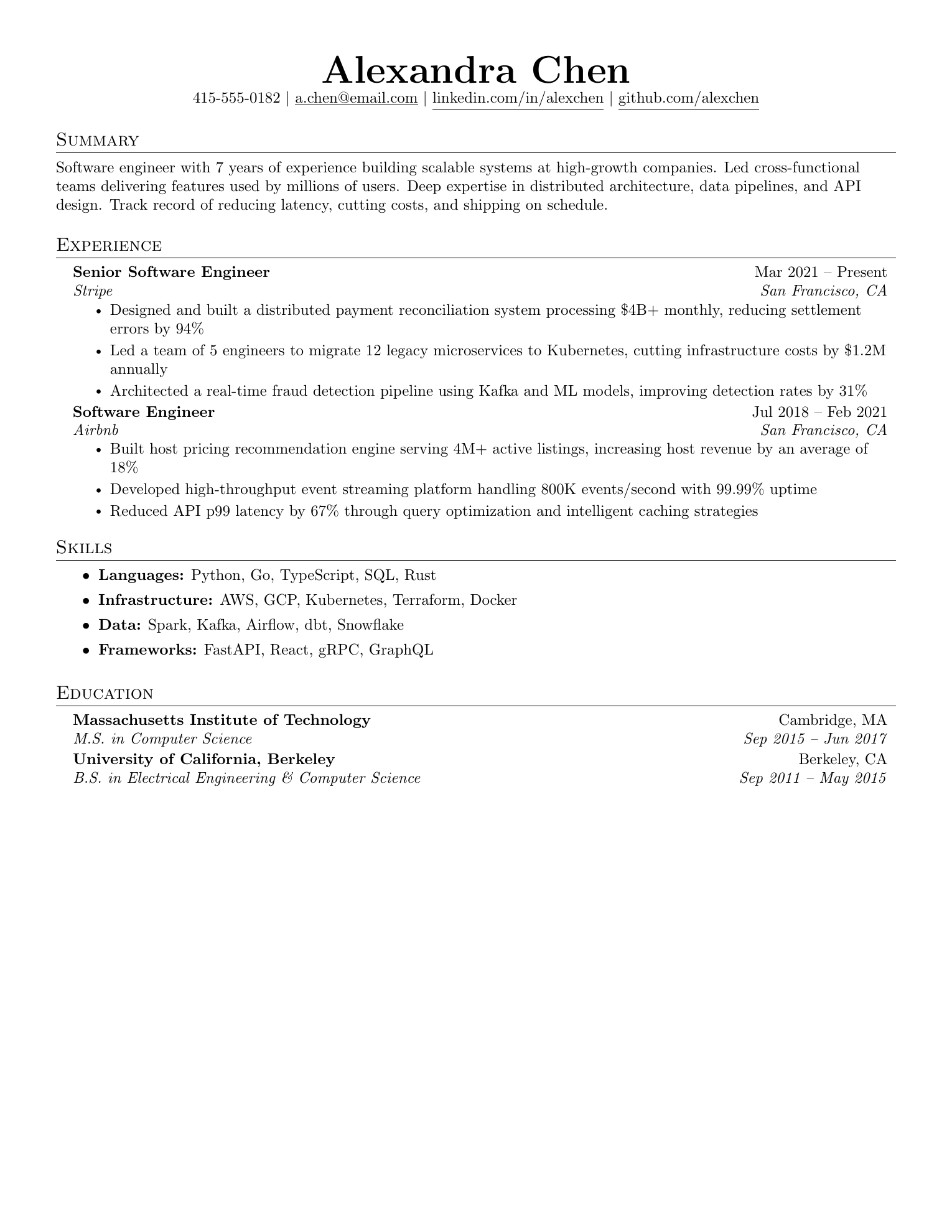
Classic resume template preview

Classic

For engineering roles, the Classic template is the safest bet. It’s the format most ATS systems parse cleanly, most hiring managers expect, and most interviewers find easy to skim during a phone screen. No colored headers, no sidebars, no design flourishes — just well-organized content in a single-column serif layout that puts your experience front and center.

If you’re applying to startups or design-adjacent teams, the Modern template (with teal accents and a sans-serif font) is a good alternative. But when in doubt, Classic is the one that never raises eyebrows.

Use this template

Frequently asked questions

Should a software engineer resume be one page?
Yes, for most engineers with under 10 years of experience. Hiring managers at tech companies typically spend 15–30 seconds on an initial resume scan, so a single focused page is more effective than two pages of padding. If you have 10+ years, a second page is acceptable — but only if the content is genuinely relevant to the role you’re applying for.
What should a software engineer put on their resume with no experience?
Lead with a Projects section instead of Experience. Include personal projects, open source contributions, hackathon entries, or coursework projects — anything where you wrote real code that solved a real problem. List the tech stack, describe what the project does in one line, and add 2–3 bullets about what you built and why. A strong GitHub portfolio link is also a powerful signal for entry-level roles.
How do I tailor my software engineer resume for a specific job?
Read the job posting carefully and identify the 3–4 core requirements. Then reorder your bullet points so the most relevant experience is at the top of each role, and mirror the language the company uses (e.g., if they say “microservices” don’t write “distributed systems”). Don’t add skills you don’t have — instead, reframe existing experience to highlight the overlap. Tools like Turquoise can automate this tailoring while preserving your authentic voice.

Ready to tailor your engineering resume?

Turquoise builds a tailored, ATS-friendly resume for any software engineering role in minutes — not a generic template, but a resume rewritten for the specific job you’re applying to, using your real experience.

Try Turquoise free