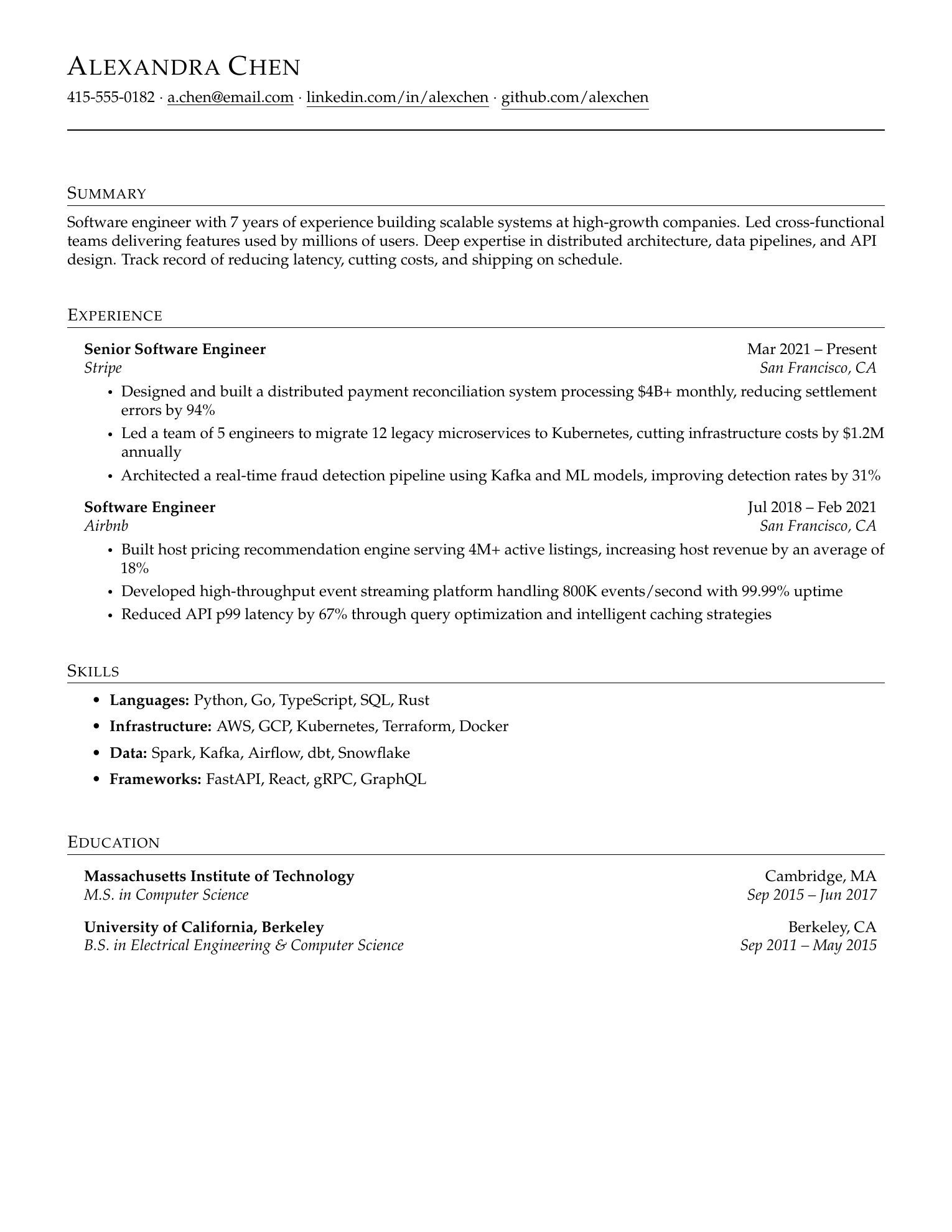
A template built for registered nurse roles — designed to surface specialty certifications, patient acuity, unit type, and the clinical competencies that nurse managers and recruiters use to match candidates to the right floor.
Tailor yours nowBSN, RN, CCRN with 5 years of MICU experience at a Level 1 trauma center (Houston Methodist). Manages 2-patient ICU assignments with ventilator management, vasoactive drip titration, and CRRT. Charge nurse 3 shifts per week with 96% bed-turnover compliance. ACLS, BLS, PALS certified. Epic power user (Rover, SmartPhrases, flowsheets).
Clinical: Ventilator management, vasoactive drip titration, CRRT, arterial line monitoring, central line care, rapid response, SBAR, sedation management, post-cardiac-arrest care Certifications: BSN, RN (Texas), CCRN, ACLS, BLS, PALS EHR: Epic (Rover, SmartPhrases, flowsheets, medication administration) Leadership: Charge nurse, preceptor, rapid response lead
Nurse managers hire for specific units, not generic “nursing experience.” A MICU nurse at a Level 1 trauma center does completely different work than a med-surg nurse at a community hospital. Name your unit type, bed count, facility designation, and typical patient acuity in the first bullet. “24-bed MICU at a Level 1 trauma center” tells a recruiter exactly where you fit.
In nursing, certifications gate hiring. CCRN, ACLS, PALS, TNCC, ENPC — list every active certification you hold, ideally right after your name in the summary or in a dedicated line. A recruiter scanning 200 RN resumes will search for these abbreviations. If they are buried in paragraph text, they will be missed.
Plenty of RN resumes say “provided patient care in the ICU.” The ones that land interviews name specific clinical competencies: ventilator management, vasoactive drip titration, CRRT, arterial line monitoring, central line care. These are the skills that tell a nurse manager whether you are ready for their unit’s acuity on day one.
If you have served as charge nurse, preceptor, or rapid response lead, surface it prominently. These are the leadership signals that get you into clinical ladder promotions, NP programs, and CRNA tracks. A bullet like “charge nurse 3 shifts per week, 96% bed-turnover compliance” tells a hiring manager you can run a unit, not just work on one.
Include the ones you actually have. Leave out the ones you’d struggle to discuss in an interview.
Reverse chronological order. Every hospital recruiter and nurse manager expects it, and ATS systems parse it cleanly. Put your most recent position first, followed by earlier roles in descending order.
Use a single-column layout. Two-column and sidebar formats look polished in a browser but routinely break when parsed by applicant tracking systems like iCIMS, Workday, and Taleo — the three most common in healthcare hiring. A clean, single-column structure with clear section headers (Summary, Experience, Skills, Education, Certifications) ensures nothing gets lost.
Keep it to one page unless you have 10+ years of experience across multiple specialties. A focused one-page resume with quantified bullets beats a padded two-page resume every time.
Your summary is the first thing a nurse manager reads. In 2–3 lines, it should answer: What is your highest credential? What unit and acuity level have you worked? What are your strongest clinical competencies?
A strong summary names your degree, licensure, specialty certifications, unit type, facility level, and 2–3 headline procedures. For example: “BSN, RN, CCRN with 5 years of MICU experience at a Level 1 trauma center. Manages 2-patient ICU assignments with ventilator management, vasoactive drip titration, and CRRT.”
Avoid summaries that open with “compassionate nurse seeking a challenging role.” These waste your most valuable real estate on adjectives that every applicant claims. Lead with your credentials and clinical scope — the specifics that differentiate you from the other 200 applicants.
“Provided patient care” tells a recruiter nothing. “Managed 2-patient ICU assignments with ventilator management and vasoactive drip titration” tells them exactly what you can handle on day one. Replace duty statements with specific procedures, patient volumes, and measurable outcomes.
CCRN, ACLS, PALS, and TNCC should be visible within the first third of your resume. Nurse managers use these as search terms when filtering candidates. If they are buried at the bottom under education, an ATS keyword scan may still pick them up, but a human reviewer skimming for 10 seconds will miss them.
General resume templates do not account for clinical rotations, credentials after your name, scope-of-practice terminology, or the EHR systems that healthcare employers expect to see. A template designed for registered nurses structures these elements where recruiters look for them.
If you are a new grad RN with no work experience, your clinical rotations are your experience section. Treat each rotation like a job entry: name the unit type, bed count, patient population, and the procedures you performed (not just observed).
Your capstone or preceptorship deserves the most detail. Include shift length, patient load, and specific competencies you demonstrated. “120-hour preceptorship in a 30-bed cardiac step-down unit, managing 4-patient assignments with telemetry monitoring and post-catheterization care” is far stronger than “completed clinical hours.”
Add your NCLEX pass date, BLS, and any specialty certifications earned during school. Even without paid experience, a new grad with specific clinical rotation descriptions will outperform one whose resume just says “nursing student.”
Most hospitals use applicant tracking systems (iCIMS, Workday, Taleo) to filter resumes before a human ever sees them. These systems parse your resume into structured fields and match keywords against the job posting.
To pass ATS screening: use standard section headers (Experience, Education, Skills — not “My Journey” or “Professional Background”). Spell out certifications and include the abbreviation (“Basic Life Support (BLS)”). Name the specific EHR systems you know (Epic, Cerner, MEDITECH). Avoid tables, text boxes, headers/footers, and images — ATS systems skip or mangle all of these.
Match the job posting’s exact phrasing where it overlaps with your real experience. If the posting says “ventilator management,” use “ventilator management” — not “vent management” or “mechanical ventilation support.”
For registered nurse roles, the Professional template works best. Nurse managers and hospital recruiters scan resumes quickly — clean formatting, clear section headers, and visible certifications are what matter. Avoid overly creative layouts; healthcare hiring systems are conservative, and a well-organized one-page resume signals the same precision you bring to clinical documentation.
Use this templateTurquoise builds a tailored, ATS-friendly resume for any registered nurse role in minutes — structured around the specialty certifications, clinical competencies, and unit-specific experience that nurse managers actually scan for.
Try Turquoise free