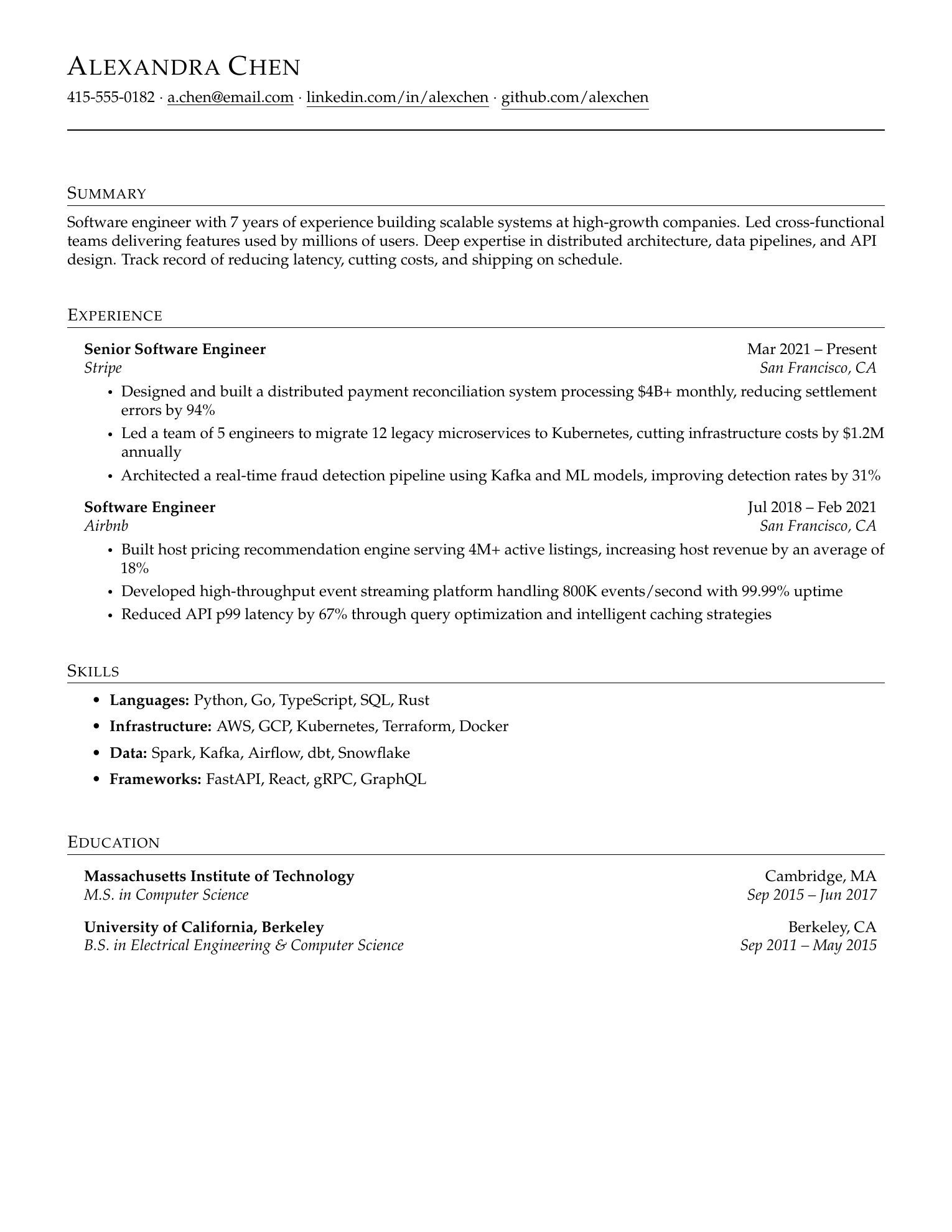
A template built for QA engineers who do more than file bug reports — structured to showcase test automation depth, CI/CD integration, coverage metrics, and the quality outcomes that engineering managers actually care about.
Tailor yours nowSenior QA engineer with 6 years of experience building test automation frameworks that ship software faster without shipping bugs. At Atlassian, architected the end-to-end testing infrastructure for Jira Cloud, reducing bug escape rate from 11% to 2.8% while cutting release cycle time by 40%. Deep expertise in Selenium, Cypress, and Playwright across web and mobile, with a track record of making CI/CD pipelines the quality gate, not the bottleneck.
Automation: Selenium, Cypress, Playwright, Appium, Pytest, JUnit Languages: Python, Java, TypeScript, JavaScript CI/CD & Tools: GitHub Actions, Jenkins, Docker, Percy, Pact, Postman, Datadog Methods: API Testing, Performance Testing, Contract Testing, Visual Regression, Mobile Testing
Every QA engineer can say they “wrote automated tests.” What separates a strong resume is showing what those tests actually prevented. The best QA bullets connect your automation work to measurable quality outcomes: bug escape rates, production incident reduction, release cycle acceleration. “Reduced bug escape rate from 11% to 2.8%” tells a hiring manager that your testing strategy actually works. If your bullet stops at “wrote 500 test cases,” you’re describing effort, not impact.
Listing “Selenium, Cypress, Playwright” on your skills section tells a hiring manager nothing about your proficiency. What they want to see is evidence in your bullet points: did you build the framework from scratch or add tests to an existing one? Did you implement parallel execution? Custom reporting? Retry logic for flaky tests? The difference between a junior QA engineer and a senior one isn’t which tools they’ve used — it’s whether they’ve architected the testing infrastructure or just contributed to it.
In 2026, a QA engineer who can’t work with CI/CD pipelines is increasingly unhirable at top companies. Your resume should show that your tests don’t just run locally — they’re integrated into the deployment pipeline as quality gates. If you’ve configured test stages in GitHub Actions, Jenkins, or CircleCI, or if you’ve optimized pipeline runtime through parallelization and smart test selection, make that prominent. It signals that you think about testing as part of the delivery process, not a separate activity.
Most QA resumes are heavy on UI automation and light on everything else. If you have experience with load testing (k6, Locust, JMeter), API testing (Postman, REST Assured), or contract testing (Pact), call it out explicitly. These skills are in high demand and relatively scarce. An engineer who can validate both the user interface and the service layer underneath it is significantly more valuable than one who can only do one or the other.
Include the ones you actually have. Leave out the ones you’d struggle to discuss in an interview.
QA engineers need a resume that communicates precision and structure — the same qualities you bring to your testing work. The Professional template’s clean Palatino layout gives your resume the polished, methodical look that engineering managers expect, while keeping dense technical bullets (framework names, coverage percentages, pipeline configurations) easy to scan.
If you’re targeting startups or DevOps-heavy teams, the Classic template is a solid alternative. But for most QA roles at mid-size to large companies, Professional is the right call.
Use this templateTurquoise builds a tailored, ATS-friendly resume for any QA engineering role in minutes — structured to highlight your automation depth, CI/CD integration, and the quality outcomes your testing delivered, using your real experience.
Try Turquoise free