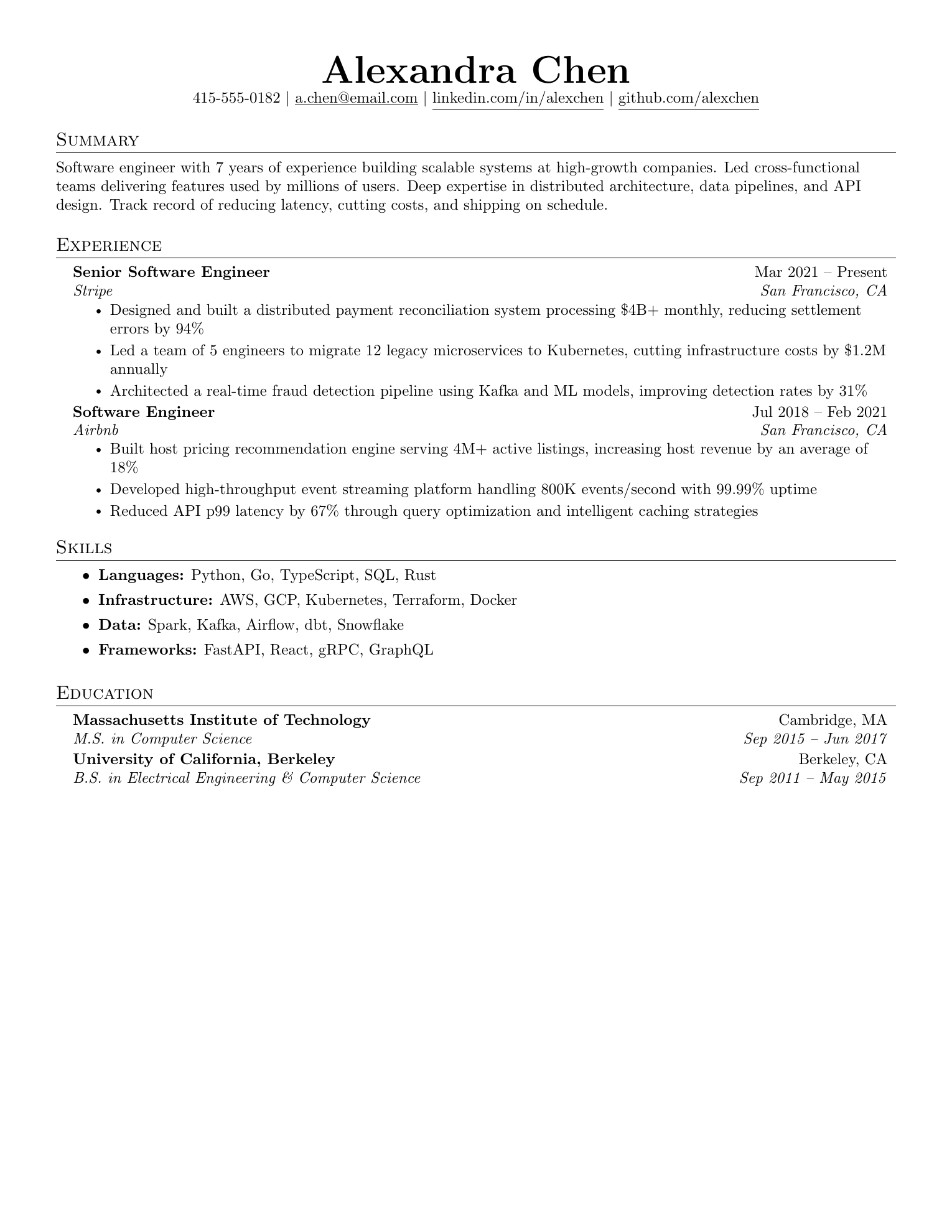
A template built for full stack engineers who ship end-to-end — structured to showcase the React and Node.js depth, API design, performance work, and production ownership that engineering managers actually evaluate in a resume screen.
Tailor yours nowFull stack engineer with 5 years of experience building and scaling web applications from database to deployment. Currently leading feature development on Shopify’s merchant analytics platform, where I architected a real-time dashboard serving 200K+ merchants that reduced page load time by 62% and increased daily active usage by 34%. Deep expertise in React, Node.js, and PostgreSQL with a track record of owning features end-to-end — from API design through frontend implementation to production monitoring.
Frontend: React, TypeScript, Next.js, Redux, Tailwind CSS, Webpack Backend: Node.js, Express, PostgreSQL, Redis, GraphQL, REST API design Infrastructure: AWS (ECS, RDS, Lambda, S3), Docker, GitHub Actions, Datadog Practices: System design, CI/CD, code review, on-call ownership
Every full stack engineer can list React and Node.js. What separates a strong resume from a generic one is showing that you owned a feature from database schema through API design to frontend implementation and production monitoring. “Built a messaging template system end-to-end (React frontend + Node.js/Express API + PostgreSQL), used by 40K+ customers” tells a hiring manager you can operate across the entire stack without needing someone to hand you the API contract. That autonomy is the whole point of hiring a full stack engineer.
Nothing demonstrates technical depth faster than a performance improvement with real numbers. “Reduced average query time from 3.2s to 180ms through index redesign and query plan analysis” tells a hiring manager three things at once: you understand database internals, you can profile and diagnose production issues, and you measure your work. Any engineer can build a CRUD app. The ones who can make it fast at scale are the ones who get senior offers. If you’ve done performance work, lead with it.
At the mid-to-senior level, hiring managers care less about which framework you used and more about why you chose it. “Led migration from a monolithic Rails app to a React/Node.js microservice, reducing deploy times from 45 minutes to 8 minutes” is a bullet about architectural judgment, not framework preference. It shows you understood the problem (slow deploys, tight coupling), proposed a solution (service extraction), and measured the outcome. That’s what system design interviews are testing for — and your resume should preview that capability.
Server response time and deploy frequency matter, but they’re means to an end. The strongest full stack resume bullets connect technical work to user outcomes: “increased daily active usage by 34%” or “cut onboarding drop-off by 18%.” If you reduced page load time, say what that meant for users. If you built a new API, say how many developers or customers used it. Hiring managers are looking for engineers who understand that shipping code is a means to moving a product metric, not an end in itself.
Include what you can defend in a technical interview. Leave off anything you last touched in a tutorial.
For full stack engineering roles, the Classic template is the best fit. Its clean Georgia serif font and minimal layout let your technical accomplishments speak without visual distraction. Engineering hiring managers and ATS systems both parse it effortlessly. No sidebar, no columns, no design flourishes — just the structured, scannable format that lets a reader evaluate your stack depth and impact in under 10 seconds. Engineering resumes should look like engineering: precise, clean, and functional.
Use this templateTurquoise builds a tailored, ATS-friendly resume for any full stack role in minutes — structured to highlight your end-to-end delivery, API design, and the production systems you’ve built and scaled, using your real experience.
Try Turquoise free