Data Analyst Resume Template

A template built for mid-level data analysts who go beyond pulling reports — structured to showcase the SQL depth, experimentation design, dashboard building, and business impact that hiring managers at data-driven companies are looking for.

Tailor yours now
Sarah Kim
sarah.kim@email.com | (734) 555-0218 | linkedin.com/in/sarahkim-data
Summary

Data analyst with 4 years of experience turning complex datasets into actionable business insights. Built Spotify’s experimentation platform for podcast recommendations, designing A/B tests that increased listener engagement by 18% and directly influenced the product roadmap. Combines deep SQL and Python proficiency with strong statistical reasoning and a track record of presenting findings that drive executive-level decisions.

Experience
Senior Data Analyst
Spotify New York, NY
  • Built and owned the experimentation platform for the podcast recommendations team, designing 25+ A/B tests that drove an 18% increase in listener engagement and a 12% lift in weekly active listeners
  • Developed a cohort analysis framework in Python (pandas, scipy) to measure long-term retention impact of product changes, replacing ad-hoc queries with a reproducible pipeline that reduced analysis time from 3 days to 4 hours
  • Created executive-facing Looker dashboards tracking product KPIs across 8 markets, becoming the primary data source for quarterly business reviews and influencing $15M in feature investment decisions
Data Analyst
Wayfair Boston, MA
  • Built a customer segmentation model using k-means clustering on purchase behavior data (2M+ customers), which the marketing team used to reallocate $3.2M in ad spend and improve ROAS by 26%
  • Designed and maintained a revenue attribution dashboard in Tableau connecting marketing touchpoints to conversions, resolving a 6-month dispute between marketing and finance on channel effectiveness
  • Wrote and optimized 200+ SQL queries in Snowflake powering daily reporting for the merchandising team, reducing average query runtime by 65% through indexing strategies and CTE refactoring
Skills

Languages & Tools: SQL (Snowflake, BigQuery), Python (pandas, scikit-learn, scipy), Tableau, Looker, dbt, Git, Jupyter, Excel   Methods: A/B Testing, Statistical Modeling, Cohort Analysis, Customer Segmentation, Revenue Attribution, Experiment Design

Education
B.S. Statistics
University of Michigan

What makes a strong data analyst resume

Quantify everything — especially the decisions your analysis drove

Every data analyst can say they “analyzed data and provided insights.” What separates a strong resume is showing what those insights actually changed. The best bullets follow a clear arc: you analyzed something specific, discovered a finding, and that finding drove a measurable business outcome. “Built a customer segmentation model that informed a $3.2M ad spend reallocation, improving ROAS by 26%” tells the full story — from the analysis you did to the decision it enabled. If your bullet stops at “delivered insights to stakeholders,” you’re leaving the most important part out.

Technical depth matters at the mid-level

At the junior level, knowing SQL and being comfortable in Excel is enough. At the mid-level, hiring managers want to see that you’ve moved beyond basic queries. They’re looking for window functions, CTEs, query optimization, and the ability to work with complex data models. On the Python side, pandas is table stakes — but showing that you’ve used scipy for statistical testing, scikit-learn for segmentation, or built reproducible analysis pipelines signals that you can handle the kind of ambiguous, technically demanding work that mid-level roles require. Don’t just list tools; show how you used them to solve real problems.

Show progression from executing queries to owning analysis

The biggest differentiator between a junior and mid-level data analyst is autonomy. Junior analysts run queries that someone else scoped. Mid-level analysts identify the question, design the analysis, choose the methodology, and present the findings. Your resume should show this progression explicitly. If your earlier role involved “building dashboards and running weekly reports” and your current role involves “designing the experimentation framework and presenting findings to the VP of Product,” that trajectory tells a hiring manager you’re ready for the next step.

Experimentation and causal inference are increasingly expected

A/B testing isn’t just for data scientists anymore. More and more data analyst roles — especially at tech companies — expect you to design experiments, calculate sample sizes, interpret results, and understand when correlation isn’t causation. If you’ve designed A/B tests, run significance testing, or built experimentation frameworks, make sure that’s prominent on your resume. It’s one of the clearest signals that you think rigorously about data, not just descriptively.
Key skills for data analyst resumes

Include the ones you actually have. Leave out the ones you’d struggle to discuss in an interview.

Technical Skills

SQL Python R Tableau Looker Power BI BigQuery Snowflake dbt pandas scikit-learn Excel Jupyter Git

What Data Analyst Interviews Focus On

SQL Proficiency Experimental Design Statistical Reasoning Product Sense Data Storytelling Stakeholder Management Ambiguity Tolerance Business Acumen Metric Design Root Cause Analysis

Recommended template for data analyst roles

Professional resume template preview

Professional

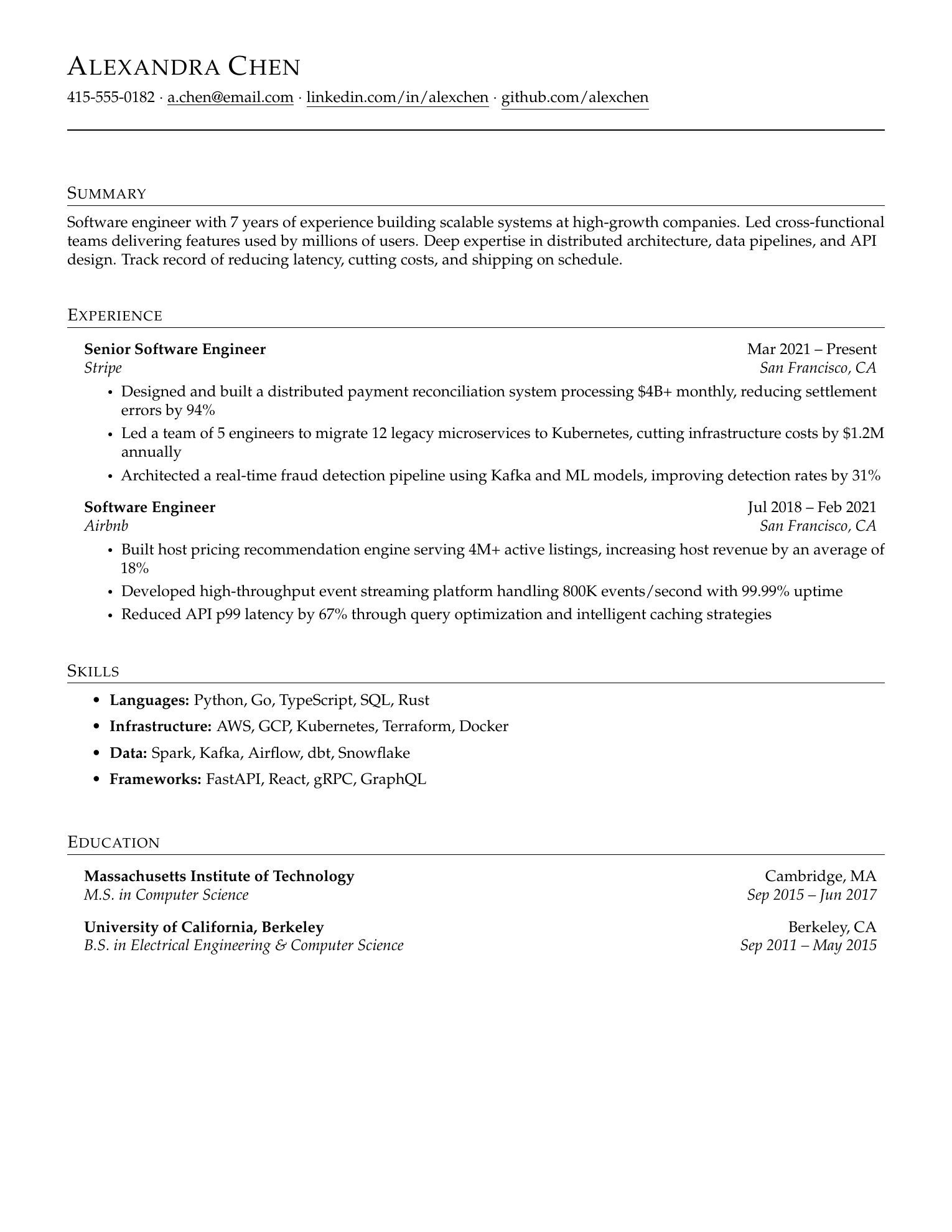
For data analyst roles, the Professional template strikes the right balance between technical credibility and clean readability. Its Palatino serif font and structured layout give your resume the polished, detail-oriented look that analytics hiring managers expect — without the visual noise that can distract from the quantitative impact in your bullet points. Clean, structured, and easy to scan — exactly how a data analyst’s work should be.

Use this template

Frequently asked questions

Should I list every SQL dialect I know?
No, pick your primary. Employers care that you can write complex queries, not which flavor. Listing “PostgreSQL, MySQL, SQL Server, BigQuery SQL, Snowflake SQL” just looks like padding. Pick the one or two you use most and let your bullet points demonstrate depth — things like window functions, CTEs, and query optimization matter far more than dialect breadth.
How do I show impact when my analysis was part of a team decision?
Frame your specific contribution. “Built the segmentation model that informed the marketing team’s $2M budget reallocation” is honest and shows ownership without overclaiming. You don’t need to say you single-handedly drove the decision — just make clear what your analytical contribution was and what it enabled.
Is dbt worth learning for a data analyst?
Increasingly yes. Analytics engineering is merging with traditional DA work, and the analysts who can own the data model AND the analysis are significantly more valuable. If you can build clean, tested, version-controlled transformations in dbt and then analyze the output in Tableau or Looker, you’re covering the full stack from raw data to insight — and that’s exactly what modern data teams want.

Ready to tailor your data analyst resume?

Turquoise builds a tailored, ATS-friendly resume for any data analyst role in minutes — structured to highlight your SQL depth, experimentation design, and the business decisions your analysis drove, using your real experience.

Try Turquoise free