What makes a strong backend engineer resume
Lead with scale, not just the technology stack
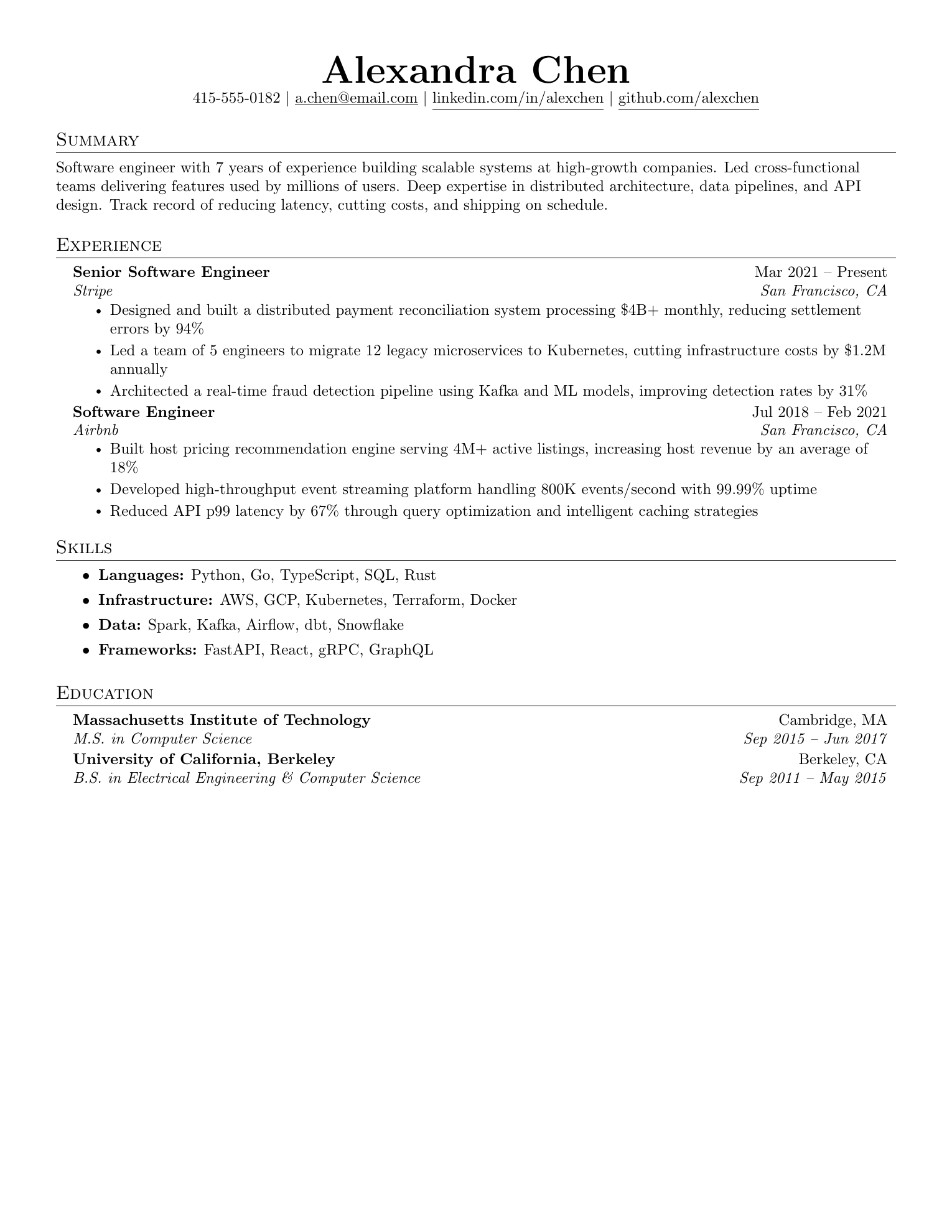
Every backend engineer can list Go, Python, and PostgreSQL. What separates a strong resume is showing the scale at which you operate those tools. “Built a service in Go” tells a hiring manager nothing. “Built a rate-limiting service in Go that protects 14 microservices and reduced incident frequency by 62%” tells them you think about systems, not just code. The best backend resumes quantify requests per second, uptime percentages, data volumes, and latency targets — because those are the numbers that define whether a system actually works in production.
Show that you own reliability, not just features
Backend engineering is fundamentally about building things that don’t break. Feature delivery matters, but hiring managers at companies like Datadog, Stripe, and Cloudflare are specifically looking for engineers who think about failure modes, SLAs, and incident prevention. If you’ve reduced on-call escalations, improved uptime from 99.9% to 99.99%, or built circuit breakers and retry logic, those accomplishments deserve prominent placement. They signal that you understand production systems — not just development environments.
Performance optimization is your highest-leverage bullet point
Latency reductions are among the most concrete, impressive things you can put on a backend resume. “Reduced p99 latency from 340ms to 45ms” is instantly understood by any technical interviewer. It implies profiling, architectural thinking, and a deep understanding of the system under load. If you’ve optimized query performance, redesigned data pipelines, or eliminated bottlenecks, lead with the before/after numbers. They’re more compelling than any project description.
Infrastructure cost savings demonstrate engineering maturity
Junior engineers focus on making things work. Senior engineers focus on making things work efficiently. Showing that you reduced infrastructure costs — whether through autoscaling, caching strategies, or architectural decisions — signals to a hiring manager that you think about the business impact of your technical choices. “Reduced infrastructure costs by $180K annually” isn’t just an engineering accomplishment; it’s a business case for hiring you. Don’t leave money on the table when writing your resume.